



In 2007 Mohnish Pabrai wrote The Dhandho Investor: The Low-Risk Value Method to High Returns.
This is Amazon’s review of the book.
In a straightforward and accessible manner, The Dhandho Investor lays out the powerful framework of value investing. Written with the intelligent individual investor in mind, this comprehensive guide distills the Dhandho capital allocation framework of the business savvy Patels from India and presents how they can be applied successfully to the stock market. The Dhandho method expands on the groundbreaking principles of value investing expounded by Benjamin Graham, Warren Buffett, and Charlie Munger. Readers will be introduced to important value investing concepts such as “Heads, I win! Tails, I don’t lose that much!,” “Few Bets, Big Bets, Infrequent Bets,” Abhimanyu’s dilemma, and a detailed treatise on using the Kelly Formula to invest in undervalued stocks. Using a light, entertaining style, Pabrai lays out the Dhandho framework in an easy-to-use format. Any investor who adopts the framework is bound to improve on results and soundly beat the markets and most professionals.
Mohnish Pabrai is a successful hedge fund manager. His style is to invest in highly undervalued stocks which have an economic moat, in other words, little or no competition. Such shares are often unrecognised by the market, unloved or overlooked. Pabrai has the ability to discover these hidden gems.

Dhandho (pronounced dhun-doe) is a Gujarati word. Dhan comes from the Sanskrit root word Dhana meaning wealth. Dhan-dho, literally translated, means “endeavours that create wealth.” The street translation of Dhandho is simply “business.” What is business if not an endeavour to create wealth? (P.2 Dhandho Investor).
His approach has been influenced by Indians from the Gujarati area of India who are very shrewd business people. He tells the story of how the Gujaratis came to dominate the motel industry in the US despite representing a tiny proportion of the US population i.e. less than 1%. Back in the seventies, the motel industry was on its knees. Motel occupancy rates were very low and motels were song money hand over fist.
Gujaratis, typically with the surname Patel, discovered that with just $5,000 capital they could get bank funding to buy motels at a discount of as much as 90%! They quickly ascertained that it would be more economic to buy a motel, move their family into it, employ their family members for free and reduce their nightly rates. Rapidly they undercut other motels and started to dominate the industry. Their motels were so profitable they quickly bought more.
Patels are now estimated to own between 80 and 90 percent of the motels in small towns and Indian-Americans overall dominate the hospitality industry, according to the Asian American Hotel Owners Association, an advocacy group for Asian hotel/motel owners.
So the Dhandho way is to invest at such a large discount that the downside risk is low, you may lose a little, but the upside potential is high meaning you will probably make a lot of money.

Pabrai also describes the Kelly Formula.
The Kelly Formula is a mathematical formula that helps investors and gamblers calculate what percentage of their money they should allocate to each investment or bet.
The Kelly’s formula is : Kelly % = W – (1-W)/R where:
- Kelly % = percentage of capital to be put into a single trade.
- W = Historical winning percentage of a trading system.
- R = Historical Average Win/Loss ratio.
This approach turns the diversification of risk principle upside down even though it has been proven to work in practice.
In a nutshell, by using the Kelly Formula you increase the probability of greater investing or gambling success by investing disproportionate amounts where the probable outcome will be successful. It won’t work on every occasion. You will still have winners and losers but on average you will be more successful. This isn’t a strategy for the faint-hearted though.
Interestingly, diversification of investment risk or not keeping all of your eggs in one basket doesn’t make you fabulously rich. However, what it does do is reduce the volatility of your portfolio and reduce the likelihood of catastrophic loss.
After all, the richest people in the world keep all of their eggs in one basket. Look at the examples of Elon Musk, Jeff Bezos and Bill Gates to name just three of the richest men in the world. They achieved such great wealth by keeping all of their eggs in one basket.
As the legendary Warren Buffett once said “Keep all your eggs in one basket, but watch that basket closely.”
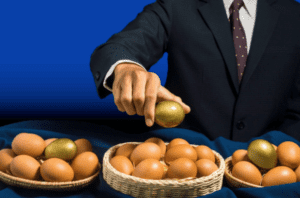
Being fund managers we cannot put all of our eggs in one basket. However, we do very much believe in investing in under-valued stocks. We also run a high conviction, concentrated portfolio of just 28 stocks. Typically a fund has 40-50 stocks in it. Our top 10 holdings make up 50% of our fund, the CCM Intelligent Wealth Fund.
So if you are considering investing and you do like to choose funds that specialise in buying under-valued stocks in a high conviction, concentrated portfolio of stocks, look no further than the CCM Intelligent Wealth Fund. You know it makes sense.*
*The value of investments and the income derived from them may fall as well as rise. You may not get back what you invest. This communication is for general information only and is not intended to be individual advice. You are recommended to seek competent professional advice before taking any action. All statements concerning the tax treatment of products and their benefits are based on our understanding of current tax law and HM Revenue and Customs practice. Levels and bases of tax relief are subject to change. This blog is based on my own observations and opinions.


