


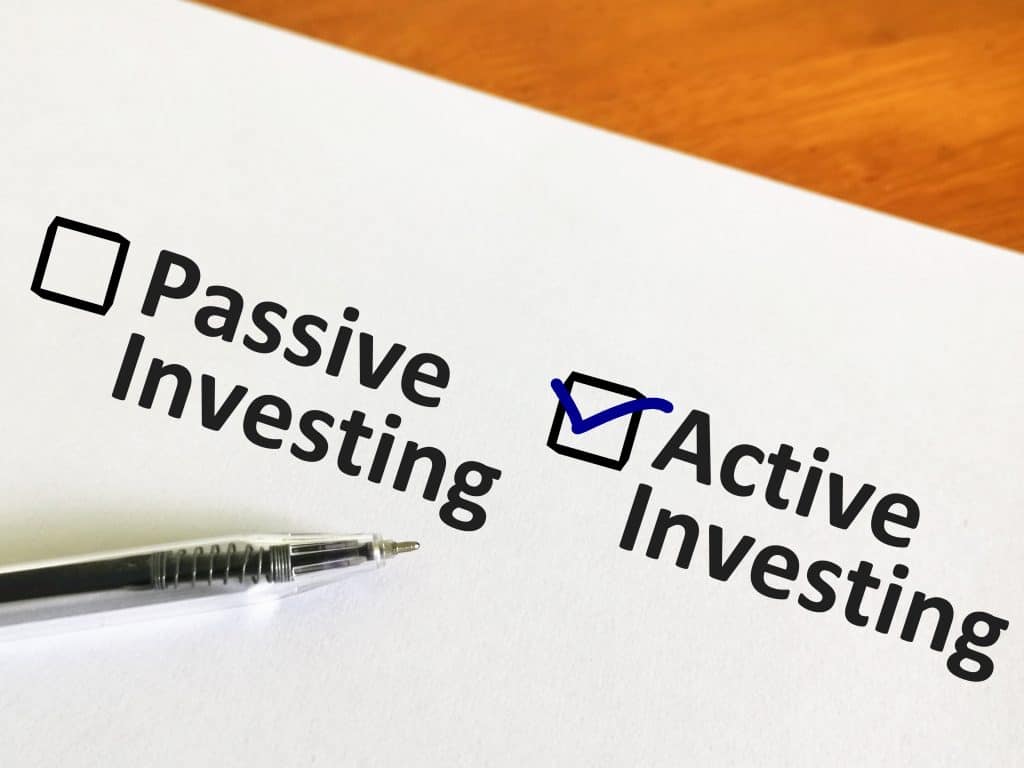
Do active fund managers truly manage their funds actively to justify the higher fees they charge than passive funds? The FCA produced two studies of the fund management industry in 2017 and 2019. Its verdict was damning. Amongst the many failings of the industry was strong evidence that many so-called active funds were no more than closet index tracker funds. In other words, many fund managers were merely following the benchmark index by replicating the shares in that index and not independently researching shares and investing in them instead. Furthermore, they were charging higher active management fees for the privilege rather than the low fees that passive funds charge.
In financial literature, there are numerous studies showing that the average collective investment fund manager underperforms their benchmark index after fees. In 2006, Martijn Cremers and Antti Petajisto of the Yale School of Management introduced Active Share, a new method of determining the extent of active management being employed by collective investment fund managers and a tool for finding those who do outperform.
About Active Share
Active Share is the percentage of fund holdings that is different from the benchmark holdings. A fund that has no holdings in common with the benchmark will have an Active Share of 100%, and a fund that has exactly the same holdings as the benchmark considered will have an Active Share of 0%. If a fund has an Active Share of 60%, then 40% of the holdings of the fund are identical to the holdings of the benchmark, and 60% of the holdings are different (constituting either over-weights or under-weights relative to the holdings of the benchmark).
Active Share is not a measure of skill but rather measures how different the fund’s holdings are relative to the holdings of the particular benchmark considered. Any difference in performance can only come from fund positions that are different from the benchmark positions, i.e., that are ‘active’, and for any given fund, higher Active Share could lead to either underperformance or outperformance.
Research has shown that as a group and over fairly long periods of time:
- funds with low Active Shares have tended to underperform their benchmarks net of costs
- funds with high Active Shares have tended to outperform their benchmarks net of costs, especially among funds that do not trade frequently, among small-cap funds and among funds that do not have very large assets under management.
Active Share Calculation
Active Share can most easily be calculated as 100% minus the sum of the overlapping portfolio weights.
Here are some examples to illustrate how Active Share works for equity funds. First, any fund position in a stock that is not included in the benchmark results naturally in no overlap with the benchmark and thus contributes to a higher Active Share. Second, for fund positions in stocks that are included in the benchmark, let’s assume that a particular stock has a 2% weight in the benchmark.
- If the fund also has a 2% weight in that stock, then its holding in the stock completely overlaps with the weight of that fund in the benchmark. As a result, the fund has no active (or different) weight in the stock, and thus this position contributes to a lower Active Share.
- If the fund has a 3% weight in that stock, then the fund has a 1% overweight together with a 2% overlap. The 1% overweight will contribute to a higher Active Share and the 2% overlap to a lower Active Share.
- If the fund does not own that stock at all, i.e., has a zero weight in that stock, then the fund has a 2% underweight in that stock relative to the benchmark, which contributes to a higher Active Share.
Examining 2,650 funds from 1980 to 2003, Cremers and Petajisto found the highest-ranking active funds, those with an Active Share of 80% or higher, beat their benchmark indexes by 2-2.71% before fees and by 1.49-1.59% after fees.
Active Share is also useful in identifying closet indexers—managers who claim to be active but whose portfolios are very similar to the benchmark portfolio. Identifying closet indexers is extremely important because active management fees can be a significant hurdle to outperforming the index for anyone holding a portfolio similar to its benchmark.
The Yale study also found funds tended toward low Active Share. The study states the percentage of assets under management (AUM) with Active Share of less than 60% increased from 1.5% in 1980 to 40.7% in 2003. Correspondingly, the percentage of fund assets with Active Share greater than 80% went down, from 58% in 1980 to 28% in 2003.
This change is not all explained by the growth in index tracker or passive funds. In 1980, there were very few non-index funds with Active Share of less than 60%. In 2003, funds with Active Share below 60% had risen to 20% of funds and 30% of assets under management. The authors also found Active Share and excess performance is higher among funds with fewer assets under management.
You should bear in mind that just because a fund has high active share it does not automatically follow that it will outperform a fund with low active share. The study showed better returns on average for funds with high active share.
So what does this mean to you as an investor? Well if you wish to invest in passive funds you should choose genuine low-cost index tracker funds. If you wish to invest in active funds then choose an active fund manager who genuinely manages a fund with high active share of 80% or more. The challenge is how to find such a fund?
Unfortunately, such information isn’t readily to hand. One method is to read active fund managers fact sheets to find out for yourself. It is surprising how often the top ten holdings are ten of the largest constituents of the relevant benchmark e.g. the FTSE 100 Share Index. Some fund managers will disclose their active share.
The good news is that the CCM Intelligent Wealth Fund is an above-average active share fund which at the time of writing has helped to achieve an excellent past performance of 64.9% over the last 12 months*.
https://www.trustnet.com/factsheets/o/oxo8/ccm-intelligent-wealth-r-inc
We conduct our own independent research and do not slavishly invest in companies purely because they are the constituents of our benchmark index the IA Global sector. That’s why our investment returns are so good. So if you are not already invested in our fund what are you waiting for? You know it makes sense**.
*The CCM Intelligent Wealth Fund’s return from March 2019 to March 2020 was -9.92% and from March 2020 to March 2021 was 49.25% (source: Funds Library).
The fund’s benchmark is the Global Index – Investment Association Global Sector, not the FTSE 100 Share Index.
**The value of investments and the income derived from them may fall as well as rise. You may not get back what you invest. This communication is for general information only and is not intended to be individual advice. You are recommended to seek competent professional advice before taking any action. All statements concerning the tax treatment of products and their benefits are based on our understanding of current tax law and HM Revenue and Customs practice. Levels and bases of tax relief are subject to change.


